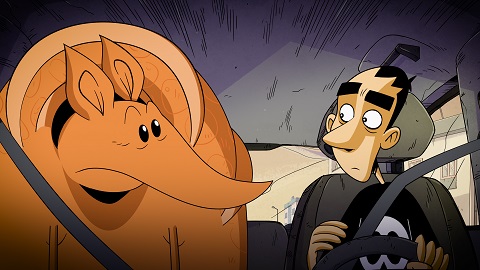
The Italian soundtrack behind My 2 Cents — Zerocalcare's Netflix series
Over 70 songs soundtrack the final chapter of Zerocalcare's animated trilogy. Here's a closer look at the Italian artists who define its emotional DNA, from Giancane's instrumental confession to De André's timeless poetry.
Netflix's My 2 Cents (Due Spicci in Italian) is the third and reportedly final chapter in cartoonist Zerocalcare's animated trilogy — following Tear Along the Dotted Line and This World Can't Tear Me Down. Released in late May 2026, the eight-episode series carries the same raw, autobiographical storytelling that made the first two entries cult objects, this time zeroing in on what it means to be thirty-something in Rome today: precarious work, friendships that fray, nostalgia that stings, and the stubborn refusal to let go of ideals.
What makes the show impossible to separate from its mood is the soundtrack. Over 70 songs are woven through the eight episodes, and Zerocalcare uses them the way he uses dialogue — as emotional shorthand. The music is never background noise. It's memory, identity, generational language. The selection bridges the Italian songbook of the last fifty years with the country's current indie landscape, and the result is a playlist that functions as a parallel narrative. Below are the Italian tracks and artists that left the deepest mark.
Giancane — the emotional spine of the entire series
If you had to reduce the soundtrack of My 2 Cents to a single name, it would be Giancane. The Roman singer-songwriter is already the unofficial musical voice of Zerocalcare's universe — his songs appeared in the previous two series — but here the collaboration reaches its peak. Fifteen tracks from Giancane's instrumental album Non ti riconosco più are threaded through every episode, often returning as refrains.
The album is a departure for Giancane. Gone are the abrasive sarcasm and shout-along choruses of earlier records like Ansia e Disagio. In their place: suspended pianos, electronic drifts, post-punk tension, and stretches of near-silence that feel closer to film scoring than traditional songwriting. The title track, Non ti riconosco più, functions as the series' emotional thesis — a slow, unresolved meditation on not recognizing yourself anymore.
Giancane described the collaboration in simple terms: every time Zerocalcare played him a scene, he realized the music was already there, waiting. The cover art for the album was drawn by Zerocalcare himself, completing a loop between image and sound that runs through the entire project.
Fabrizio De André — the ghost of Italian songwriting
Episode 4 drops La ballata dell'amore cieco into a scene that needed weight only a master could provide. De André, who died in 1999, remains the most revered figure in Italian cantautore tradition — a songwriter whose lyrics are studied in schools and quoted in bars with equal frequency.
The song is from 1971, from the album Storia di un impiegato, and it tells the story of a love that persists despite blindness, despite betrayal, despite everything. In the context of My 2 Cents — a series about people who keep failing but keep showing up — the choice is almost too perfect. Zerocalcare isn't using De André as vintage decoration. He's treating him as a contemporary, someone who already said what the characters are still trying to articulate.
Lucio Dalla — Bologna's eternal voice
Lucio Dalla's Cara appears in Episode 5, and it's the kind of choice that only works if you trust your audience completely. Dalla, who died in 2012, was one of Italy's most beloved voices — not just a singer but a storyteller whose songs mapped the geography of Italian emotion from the Po Valley to the Mediterranean.
Cara is from 1980, from the album Lucio Dalla, and it's a song of almost embarrassing directness — a love letter without irony, without defense. In a series built on defensive irony, its appearance feels like a door swinging open. For a moment, the characters stop performing detachment and just feel something. That's the power of Dalla: he makes sincerity feel possible again.
Coez — the street-level poet of contemporary Rome
Ci vuole una laurea by Coez closes Episode 8, and it's the newest voice in a soundtrack that otherwise leans heavily on the past. Coez (Silvano Albanese) is a Roman rapper and singer-songwriter who built his audience through mixtapes and independent releases before breaking into the mainstream with hits like La musica non c'è and Domenica.
His inclusion matters because he represents the same generation Zerocalcare is depicting — Romans in their thirties who came up through the city's squats, open mics, and self-released recordings. Ci vuole una laurea is a wry, exhausted anthem about the gap between education and survival, between what you were promised and what you got. It's funny and sad at the same time, which is exactly Zerocalcare's register. The song was also used in the series trailer, making it many viewers' first contact with the show's tone.
Tiziano Ferro — pop sincerity as emotional weapon
Episode 4 slips in Ti scatterò una foto by Tiziano Ferro, one of Italy's biggest pop exports of the 2000s. Ferro has sold millions of records across Europe and Latin America, and his name represents a specific era of Italian pop — polished, melodic, emotionally direct.
The song's inclusion is slightly surprising, which is why it works. Ferro's glossy production sits at the opposite end of the sonic spectrum from Giancane's stripped instrumentals, but the emotional intent is identical: looking at someone you love, trying to hold the moment before it disappears. In a series that spends so much time on friendship and the fear of losing it, the choice reads as honest rather than ironic.
Le Luci della Centrale Elettrica — indie as inheritance
Le Luci della Centrale Elettrica contribute Chakra to Episode 7, representing the thread of contemporary Italian indie that runs through the soundtrack. The project, fronted by Vasco Brondi, emerged from the same post-rock and folk-adjacent scene that produced bands like Verdena and Afterhours — guitar-driven, lyrically dense, unafraid of scale.
Their inclusion alongside De André and Dalla makes a quiet argument: Italian indie isn't a break from tradition, it's an inheritance. The same preoccupations — place, memory, friendship, defeat — run through Brondi's writing as through the songbook classics. Chakra arrives in one of the series' most introspective episodes, and its swirling, slowly building arrangement mirrors the emotional arc of the scene it scores.
The deeper cuts: El Santo, Dema, Monkeys Factory, Plakkaggio
Beyond the marquee names, My 2 Cents makes room for smaller Italian acts that deserve the spotlight. El Santo's Juda fa Juda brings a swaggering, almost cinematic energy to Episode 2. Dema's Una giornata offers a lighter, more melodic counterweight in the same episode. Monkeys Factory's Scatole di carta slips into Episode 4 with a quiet indie-pop confidence that holds its own against the giants sharing the scene.
In Episode 8, Plakkaggio's Granito delivers a harder, more abrasive texture — a reminder that the Roman underground still produces guitar music with teeth. These aren't filler tracks. Each one was chosen because it says something the dialogue can't, or because it carries a specific Roman energy that Zerocalcare wanted in the room.
Why the soundtrack matters for artists on Spotify
A soundtrack this carefully curated does something important: it introduces songs to listeners who might never have found them otherwise. Every time a viewer finishes an episode and opens Spotify to chase down a track, that's a discovery moment — the exact behavior Spotify's algorithm is designed to amplify.
For independent Italian artists, placement in a series like My 2 Cents is the kind of exposure that can shift monthly listeners from hundreds to thousands overnight. And once those listeners arrive, a Canvas — the looping 3-to-8-second video that plays behind your track on mobile — is what keeps them from scrolling past. A static cover in a feed full of motion is a missed opportunity.
If any of the artists above make you want to see their covers in motion, that's what AnimateCover is built for. Upload the artwork, describe the movement you want, and you'll have a 9:16 MP4 ready for Spotify for Artists in minutes.